Paris, Belle Époque

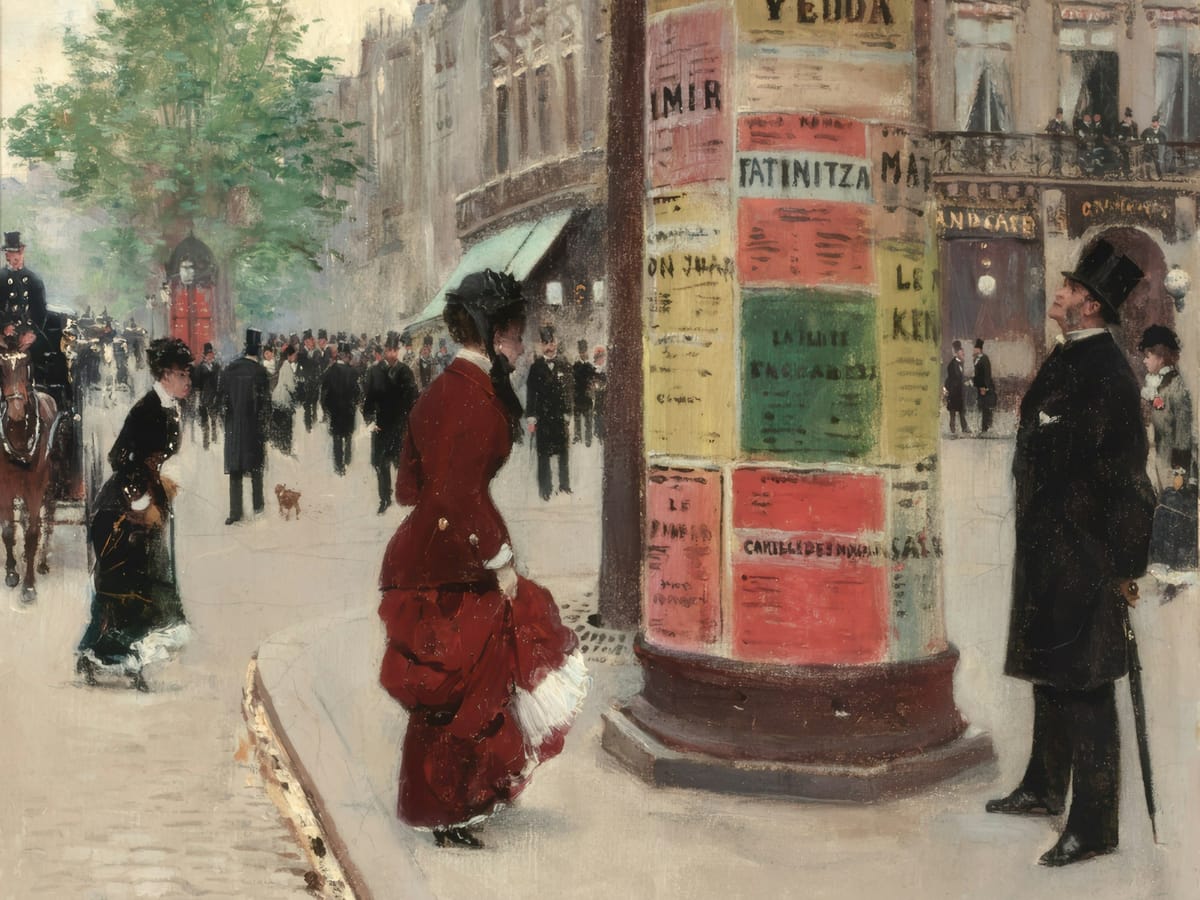
Paris’ landscape tells a story, a story of industrialisation, conflict, society, art and culture. Many will tell you that Paris’ history is a complicated one, to be deciphered and studied endlessly, but if one is careful enough, the anxieties, friction and opportunities of Paris’ most iconic time, the Belle Époque, can be read on the wrinkled face of the monuments painting its sky. The Belle Époque is remembered as a time of controversy; as Émile Zola eloquently described it, “Behind the glitter of Paris, misery crouches in every shadow.” It was a time where the quiet anxieties stemming from modernity simmered like boiling magma under a veil of luxury. The advent of industrialisation, the sudden urbanisation of the city, and the development of a consumerist society, all acted as pivotal pushes corroding the Paris known at the time, marking its history and landscape.
On February 14th of 1887, a protest letter signed by a myriad of artists, writers and musicians was published in "Le Temps" newspaper. The guardians of the arts gathered to condemn him who dared to curse Paris' landscape, commemorated by its classical and solemn Arc de Triomphe, Les Invalides, and Sacre Coeur. The letter believes the project created by the wicked Gustav Eiffel to be a dishonour to the elegant and romantic allure of the city. They believe that a bolted metallic tower would be considered a profane addition to the illustrious monuments, already dictating the city’s aesthetics and values. Gustav Eiffel, helped by Émile Nouguier and Maurice Koechlin, started planning the workings of the tall tower in 1884, so when the quest for a centrepiece for the 1889 Exposition Universelle started, Eiffel's design conquered all. Eiffel's tower is seen today as an epitome of mechanical and industrial genius; from its individually designed components to its perceptive use of iron, it represented the successes of the industrialisation process happening at the time. The purpose of the building went far beyond aesthetics, prioritising a more practical element based on functionality. He concerned himself with thorough studies of the area of Champ de Mars, studying which position was best suited to acquire a strong foundation. Furthermore, he spent endless hours studying the latter, making precise calculations based on the study of wind resistance and gravity, understanding that a less heavy tower would be able to combat strong winds better than a heavy structure. This conscious effort Eiffel placed towards the mechanical and industrial aspect of the tower is what the protesters saw as an assault. The very idea that aesthetics would be placed as a secondary function felt like a betrayal of the city’s core values and virtues. In the letter denouncing Eiffel, industrial terms used derogatorily, such as “black factory chimney” or “bolted sheet metal” served as evidence to discover the real fear those who protested had: the panic of a possible triumph of innovation over tradition. Eiffel, with his “iron syringe” challenged those who believed France to be solely a country of art, pleasure and entertainment, by establishing a strong presence of engineers and craftsmen.
After the scandalous quarrel ignited by Eiffel’s creation, Paris was faced with a choice. It could either establish its rejection of industrialisation or embrace it and find a way to aestheticise it. As a result, Art Nouveau was born as an aesthetic response to the advancements of technology shaping the city. As mass society continues to evolve and merge with the industrial age, it was obvious that new artistic and architectural ideas were going to take form. Art Nouveau was born out of an attempt to familiarise industrial materials and incorporate them into a domestic atmosphere. Materials once deemed brute and uninspiring, such as glass, iron, or steel, were now being repurposed into an organic and sensual decorative style aimed to resemble nature’s most sacred components. Industrialisation is now repackaged as a more digestible form that focuses on beauty and craftsmanship, successfully colliding functionality with aesthetics. Hector Guimard’s metro entrances are viewed as the French epitome of Art Nouveau and represent a mass-produced product that is presented as artistic and sculptural. Art Nouveau became a central hinge between industry and culture, mainly as it was the most popular architectural style employed for the grands magasins, such as the Galeries Lafayette. Industrialisation was embraced aesthetically only once it was embraced through consumption. Unlike previous rejections of industrialisation as an evil attempting to eliminate tradition, now, the growing consumer culture softened this rejection by embedding industrial production in everyday endeavours. While the Eiffel Tower epitomised industrialisation in its most raw and bold form, imposing itself over the city and the other monuments, the grands magasins were built to create fluidity, openness and approachability, orchestrated to ignite desire in people, which further lies in what was being sold. The grands magasins were shrines to mass production and industrial manufacturing. They represented the triumph of modernity over tradition, of the generic over soulful. Industrialisation was therefore made digestible through consumable and practical objects; architecture followed this formula.
The Parisian landscape of more than a century ago holds up a mirror to our own age. The architecture of the Belle Époque didn’t bend when put against industrialisation, but it negotiated with it. When it first materialised through Eiffel’s Tower, it was met with fear and outrage. Subsequently, through the gradual bargain and assimilation of industrialisation with everyday life, it was finally embraced. This points out the swift strategies through which modernity can seduce people, even blinding them from the dangers it can bring with itself, a risk we are still faced with as modernity embraces us in its arms so strongly that it might break.