The Norwegian Tax Lottery: a new frontier in economic experiments

Will people work more if they earn more, and by how much? This is a central question in business, fiscal policy and economic theory. On the individual level, it seems to vary. On the macroscopic level, it divides us politically when contradictory answers gets deducted from various political assumptions and values. Few experiments on a large scale have collected conclusive data on the impact of tax and income, which makes Norway’s tax lottery policy a creative innovation in the realm of fiscal experiments.
Background
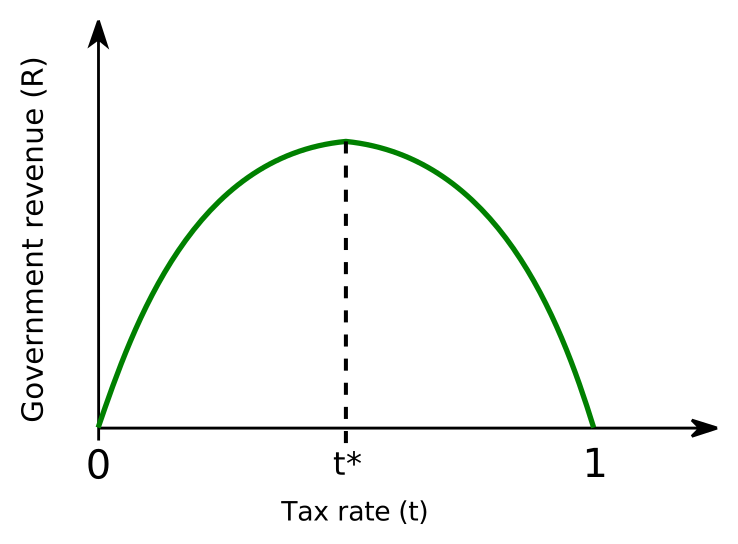
Surprisingly little empirical data exist to answer the question precisely. What governments can do is to vary tax rates and measure the impact on GDP and government revenue year-on-year, but this includes all complex factors. The relationship between tax levels and government income is captured in the Laffer Curve. The theory predicts that increasing taxes eventually decreases government income because the economy shrinks with too much taxation. The Laffer Curve suggests that there exists an optimal tax rate for government revenue and economic activity, and that well placed tax rate decreases may even enhance government revenue - making everyone better off. The problem is finding out where the Laffer curve peaks, and understanding the causality of tax on income.
What has been lacking are large-scale randomized controlled trials. To my awareness, very few such experiments have been conducted. The most significant one might be the Negative Income Tax experiments conducted in the United States between 1968 and 1982, with a few thousand households involved. Unfortunately, the insights are neither widely known nor well understood. The final reports from the two largest and most important experiments have never even been published in a broadly accessible form (Munnell, 1986).
Conducting a large-scale randomized controlled trial on the impact of tax is precisely what Norway is doing from 2026 with its “skattelotteriet”-policy, which translates to “the tax lottery”. An experiment of this scale and character is a new frontier in the history of economic experiments. The data collected will undoubtedly inform fiscal policy across the OECD for decades. For a high income country like Norway, cushioned by oil wealth but facing the long-term challenges of an aging population and high welfare dependency, the tax lottery may provide important knowledge to develop the sustainability of its social model.
The Norwegian tax lottery
How does the tax lottery work? The experiment, named “Skattelotteriet”, works as follows: about 100 000 random citizens born between 1991 and 2006 will get tax deductions on labour income. The sample size is within a control group of 1.3 million young people - almost one fourth of Norway’s population. Those who are not selected will pay tax as usual. The experiment will last from 2026 to the end of 2030. The goal is to find out if lower tax motivates young people to work more by collecting conclusive data.
However, there are some limits. One must earn between 210 000 NOK and 657 000 NOK to enjoy the benefit. After calculating progressive tax and the interval of which the tax deductions are applicable, the annual maximum extra benefit one gets is 27 500 NOK. That is 137 000 NOK in total over the 5 year period. Furthermore, close to 60 000 of the 100 000 are either earning too little or too much today to be eligible for the tax deductions, according to the Department of Finance.
It’s no coincidence for it being specifically Norwegian, too. The tax lottery requires sensitive data, like records of everyone’s income level. This is no problem for a country where everyone’s income is public information on skatteetaten.no! Furthermore, an experiment of this nature would not be possible without high trust in the government. A lack of trust would carry greater political risk and resistance. The institutions themselves must also have integrity and accountability for the experiment to have any scientific credibility. Luckily, Norway has sufficient credibility by being the world’s best democracy according to the Economist Intelligence Unit (2024).
The experiment is estimated to cost about 500 million NOK annually in lost government revenue (Rønning et al, 2025). That makes it a 2.5 billion NOK experiment!
Theoretical framework
The core theoretical framework for the Norwegian experiment is the neoclassical labour-leisure trade-off model. This model explains the fundamental economic trade-off individuals make between spending time working for income and spending time on non-work activities. The choice is balancing utility of consumption against the utility of free time. Their utility function is subject to their preference and a budget constraint formed from their wage and tax rates. The “skattelotteriet”-policy will increase the real income for participants, thereby revealing causality in the utility function of tax and income. This will trigger two competing economic forces: the substitution effect and the income effect.
The substitution effect says that leisure time becomes more expensive because the opportunity cost of working increases with salary. A more costly leisure time and the potential of more consumption utility incentives individuals to work more. Interestingly, the experiment tests people who earn less than the median income of Norway (Fløtre et al, 2025). Additionally, a higher share of the workforce with lower income are working part-time compared to higher earners. The idea is that these people will work more because of the substitution effect. Especially for the unemployed young, getting a job can have a tremendous impact for society as it reduces their wage scarring effect and it relieves the welfare state of significant expenses.
The income effect allows individuals to reach their target standard of living with less time worked because they earn more. This can motivate them to work less and consume more leisure, which counteracts the substitution effect. The income effect is assumed to replace the substitution effect after an individual has reached a satisfying consumption level and the scarce leisure time becomes invaluable. This means that the balance on the income and substitution effects are tested on individuals who earn less than most of society.
Overall, the experiment offers an invaluable test of the Laffer Curve and the labour-leisure trade-off inside a modern welfare state. It moves the debate from theoretical modelling to empirical validation, potentially providing the most robust data ever collected on young labour supply elasticities.
My opinions on its controversy, outcome and political impact
I will from this point onward share my personal opinions and predictions on the experiment.
A controversy
The policy has stirred up controversy and resistance in Norwegian media because random tax benefits violate the equality before the law principle and are viewed as unfair. I still think it is a good idea. Here's 4 reasons why:
- As it is temporal, it does not violate equality before the law in the long run.
- It can be considered a Pareto improvement because the change is making someone better off without making anyone else worse off.
- I understand why random unequal benefits may be viewed as unfair if one view equality as fairness. Yet viewing equality as fairness makes me believe that a random benefit is no different from what we call fair inside our competition driven unequal world, because we are born with unequal cards on our hands. Some are born sick and poor, while others are born healthy and rich. Unequal starting positions create enormous income differences, yet we view this as fair in the name of meritocracy. The fact that a selected group who earns less than the median salary gets a few extra monthly pays, cannot be considered unfair when merit itself is also based on the same selection concept - whether calling it God’s will, dumb luck or randomness - which makes none fundamentally less fair than the other.
- Drawbacks to the experiment can be justified with the invaluable insight it will deliver, which has the potential to improve the tax system in a way that makes most better off.
Outcome hypothesis
My hypothesis is that the sample size will not have significant different income development than the control group. I’m sure many employed people are initially going to work more to exploit the benefit they received. Still, the additional motivation for overtime work quickly fades as they grow tired from overstepping their preferred work-leisure trade-off, and they start taking the benefit for granted - which in the span of 5 years supports my hypothesis.
Furthermore, I’m breaking down the young work force by encapsulating them into 4 archetypes which from my experience describe the majority of people. The income effect is dominating by arguing with these archetypes' perspectives.
The capable. I assume that the most consumption motivated and capable people already out-earn the median income, which removes them from the experiment, or they are motivated to climb the earning ladder regardless of their tax deduction. They work more if they earn more indeed, but that was already the mission before the experiment. Therefore, the impact on the benefited sample group will be indifferent to the sample group.
The held back. This group may experience that they are working and earning less than they think they are capable of. For this group I assume it’s more probable that factors like sickness, family obligations, long hours and low pay, involuntary unemployment, lack of opportunities or lack of competence are holding them back from increasing their income rather than it being a motivation problem. A tax benefit is not going to change these factors; ergo not increasing the work-load.
The comfortable. I assume some people are comfortable with where they are because they value free time or what they do more than what they earn. Paying less tax will doubtfully make them switch careers and leave their passion. I assume the income effect dominates in a percieved comfortable life. This group may also be students who expect a higher salary after graduation. If they have a part-time job, they might get incentives to work more than before, but unlikely to the point where it damages their grades and student life.
The free-riders. When money is not needed to be worked for, it will not be worked for. This can be if it's inherited or other people are covering their expenses.
If it turns out that people do not work more from lowering the income tax, it does not mean that the experiment was without growth. I believe the experiment will yield positive impact in other forms through free time. That could lead to a great many things, like healthier citizens, higher democratic engagement, more innovation, and bigger families; all of which society desperately needs.
The political impact

The traditional political axis divides the left wing and right wing by economic policy, with the causality between tax and income as a particular divide. Getting empirical evidence to support one of the sides could have a profound political impact. I speculate that other democracies will take notice, but the political cleavage prevails. And focus might shift from taxation to free time and work itself.
If the ideas of what matters in the equality before the law principle gets re-thought following the experiment, I suspect that more government experimentation of similar character can win legitimacy and support. With this, the tax lottery might open doors for more large-scale policy trials. It could have international political impact inspiring more advanced fiscal research.
The status quo seems to be the right wing supporting the substitution effect. They typically focus on incentives, value creation and the free market. On the contrary, the left wing supports the income effect because they assume people are already working at capacity, and that it is rather structural conditions, health and family that set the limit.
When one economic force wins, will the political wings unite on an ideal labour taxation? No, it’ll be business as usual. Influencing work morale was never the primary goal of taxation. Besides, there are other valid arguments and values to adjusting the tax level up or down.
Following my hypothesis, the left wing might win more political legitimacy because a part of their worldview was validated. They will probably use the experiment as an argument for keeping tax levels high. The right wing might initially defend its position by ad hoc debating the experiment’s limits. But in the long run, dismissing science kills more ethos for a sensible right wing than embracing the income effect and changing its arguments.
The right wing’s cornerstone value of individual liberty, which justifies lower taxation, will have no less legitimacy than before. Perhaps they will shift their focus away from economic growth and towards free time when they realize that’s what lies at the intersection of individual liberty, the conservation of culture and lower taxes. In that case they will merge with an atmosphere of ideas historically driven by the labour and socialist movements - history has a sense of irony.
As time passes, the endless debates about tax will be overshadowed by the question of work itself. The demography grows older and the work force is shrinking: the younger generation must work more and pay more tax to sustain the welfare state. A paradox arises because they need free time and money to establish families and innovate to counteract the demographic challenges. The most important political impact of the experiment will therefore very well not be the conclusion itself. Rather, it might become a symbol of this paradox when it dawns upon society that the tax focused debate was a distraction from the real problem.
Sources
- Fløtre, I. A. & Strand, H. H. (Jun. 2025). “Hva er vanlig lønn i Norge?”, Statistics Norway (SSB). Retrieved from: https://www.ssb.no/arbeid-og-lonn/lonn-og-arbeidskraftkostnader/artikler/hva-er-vanlig-lonn-i-norge
- Hayes, A. (Aug. 2025). “Exploring the Laffer Curve: Tax Rates and Revenue Explained”, Investorpedia. Retrieved from: https://www.investopedia.com/terms/l/laffercurve.asp
- Jansen, V. (Des. 2025). “Skattelotteriet: De fleste tjener for mye eller for lite”, VG. Retrieved from: https://www.vg.no/nyheter/i/WvLzjr/skattelotteriet-de-fleste-tjener-for-mye-eller-for-lite
- Munnell A. H. (Sep. 1986). Lessons from the Income Maintenance Experiments: An Overview, Federal Reserve Bank of Boston. Retrieved from: https://www.bostonfed.org/news-and-events/events/economic-research-conference-series/lessons-from-the-income-maintenance-experiments.aspx
- Rønning, K. E., Fjelldalen, H. & Sindre, H. S. (Oct. 2025). “Skattelotteri kan gi unge 125.000 kroner i fradrag: – Det kan jo bli litt urettferdig”, Norwegian Broadcasting Corporation (NRK). Retrieved from: https://www.nrk.no/norge/skattelotteri-kan-gi-unge-125.000-kroner-i-fradrag_-_-det-kan-jo-bli-litt-urettferdig-1.17613965
- Economist Intelligence Unit (2024). “Democracy index 2024”, Our World In Data. Retrieved from: https://ourworldindata.org/grapher/democracy-index-eiu