The Selfish Human Nature


NOTE TO READER:
I have written this article to present the pure selfish essence of our human nature, because it can be a complex topic to discuss and can be incomprehensible for some, you will notice that the essay will involve some repetitions. This repetition is done to ensure that all of my arguments and ideas are understood to their fullest extent and to avoid any confusions.
Another point I would like to make a remark about is that this article is not fully developed in the sense that there are some ideas (like values) that are not fully explained (e.g.what factors may affect them, how they change over time…). This “simplicity” is to avoid the article being too long and boring the reader.” (The long parentheses included in the text were originally supposed to be footnotes, but the format of this essay submission does not allow for footnotes).
In this essay I will be discussing how every single act committed by human beings ultimately boils down to our selfish and self-interested (Bear in mind that in this article I will be using the concepts of selfish and self-interested interchangeably) human nature, I will also be criticizing ideas of altruism and selflessness.
To begin let us start by defining what is meant by human nature. Human nature can commonly be misunderstood to be certain characteristics that are prevalent in an individual and are the reason behind why they become the person they are. While this definition is correct, there is a minute difference that causes a big change in the way the concept of human nature is understood; by having “individual” in the definition of human nature, it creates this idea that these are “characteristics” that change from one person to the other, when in reality they are rather innate dispositions that define the entirety of mankind.
So now that we have a solid foundation of what human nature is, why can it be seen as selfish?
We can begin answering this question by looking at the debate on human nature between the European philosophers Thomas Hobbes and Jean-Jacques Rousseau in the 17th and 18th centuries. The debate revolved around whether humans were inherently “good”.
Rousseau was influenced by the idea of the ‘noble savage’. Rousseau considered that before we had any education or culture, humans were wild, but they were also good and pure. With the slow development and integration of sophisticated cultures and education, humans have lost their purity and simplicity. According to this view, it is the purity and simplicity that make humans innately “good” in nature.
Hobbes however said that life is “nasty, brutish and short”. Hobbes’ idea of human nature is that all humans do is to struggle and fight against each other in their pursuit of self-interest. He saw humans as being like machines without a moral sense inside them.
I see both views to be extreme ends of a spectrum; while Rousseau argues for the good in human nature, it is based on the goodness of individuals in a natural state and this view can be looked at through the following theory:
You could start with the idea that as humans we have certain primal instincts that are based on ensuring survival and comfort (which includes reaching gratifications). If you look at a hunter gatherer society, you can see that humans had tasks that usually boiled down to hunting and creating a safe environment to protect themselves from savage animals. With that in mind we could say that their main focus then was survival, which inherently is a selfish point of interest. If we look at the initial starting point for these hunter-gatherer societies (antedating the inventions of communities and languages), we can assume that at first humans had individualistic and isolated survivalist self-interests. Where an individual had to survive on their own, mainly due to the fact that the surrounding environment was unfamiliar to them and posed as a danger to these individuals. So people found it easier to stick to their small groups because of their hostile surroundings. But then humans evolved into a species that was able to communicate with one another, leading to the creation of communities, then provinces and eventually the world as we know it today. An important remark to make, is that the need for evolution arose from the selfish nature of wanting to survive; these communities, that eventually led to provinces that led to the world as we know it today started with the idea that: “if our isolated and individual goals are to survive, why not work together to achieve those goals”. So these communities were based on a collaboration of individualistic, isolated and self interested survivalist and comfort goals. So that now survival and comfort goals stopped being “isolated” and started being more of a shared or communal objective.
The point here is that selfishness has always been part of our human nature, and will always be, but what Rousseau may have been referring to when he said that sophisticated cultures and education “spoiled” the goodness of man, is that these sophisticated luxuries started to shine a stronger light on our selfish nature. It corrupted man in the sense that there was now a way for man to over-indulge in resources and induce his natural selfish instincts. In that sense Rousseau isn’t saying that man is bad because he is selfish but he is saying that he has been given the opportunity that no strong will could deny(On average our entire existence is based on trying to survive, with every action that you commit you lose a reciprocal amount of energy. After a certain amount of energy lost (during your lifetime) you die of natural causes (think of it as a piece of machinery that works to produce a certain product in a factory, after a certain point of using it, it starts to slow down and then eventually shutting down because it has been worn out— which in other words is just the machine’s lifespan). With this general idea in mind, we could then say that in order to ensure our individual survival, we will evolve and develop to create ideas and objects that facilitate our existence, so that we do less and lose less energy. As a result we live longer. So these artificial human inventions—what we over-indulge in— are created to do just that, make us lose less energy, and ensure our survival), an over-consumption/indulgence in the resources, which ultimately lead to further comfort (gratifications included).
On the other hand, Hobbes’ viewpoint of mankind is one that is more witnessed in our contemporary world, with all of the political and international conflicts that are going on as we speak being points of evidence of how we will fight one another in pursuit of self-interest. I will however not go too much into depth about our contemporary world and how well it correlates with Hobbes’ depiction of mankind, but rather focusing on the claim that humans lack a sense of morality, and I will be re-using my earlier example/theory of the development of individualistic-isolated selfish goal to collaborative and communal goals (of surviving and of comfort). After the initial stage of humanity where one was isolated and solely focused on his goals, we saw an integration of these individuals into communities that revolved around these ideas of selfishly-collaborative interests. In these communities man needed certain boundaries or a certain framework to work around to ensure that one can co-exist with another and achieve their selfish goals in a communal setting. That is where I believe ideas of morality, respect and empathy arose from( I do not mean to say that empathy is not an emotion that is deeply rooted in each individual, but I rather mean that now since there was a presence of a comfortable environment where man did not have to constantly feel like his survival was at risk because of his unknown surroundings, his empathy was able to flourish); morality was created to keep humans in-check. To make sure that we operate under certain laws where a person does not feel attacked for what actions might have been committed (or lack of) against them. Morals were created in pursuit of self-interest, because it is in our best interest to have certain guiding laws that coordinate our entire points of contact with one another.
From both Hobbes and Rousseau’s views on humanity, we were able to conclude that in essence human nature has, is and always will be self-interested.
I would like to now bring your attention to what many believe to be the 3 ways in which man could choose to live his life, and how they all eventually lead back to our selfish human nature.
Firstly there is to live in pursuit of pure self-interest. That is to have your entire existence revolve around creating an environment that suffices your needs to reach individual success e.g. working to make enough money to live comfortably and supply yourself with your desired luxuries. In other words it is to live purely in pursuit of your own individualistic/selfish desires. This way of living is one that is purely and directly self-interested in the sense that, all that defines your life is your desire for extreme comfort or extreme survival. An over indulgence in the ways that can help you achieve survival and comfort goals—e.g. owning multiple luxury cars or houses as a result of your dedication for that way of living—can easily lead to the loss of what Rousseau referred to as the “good” in mankind.
The second way that one could choose (Choice in this context is not the active decision making process, but rather what we have ingrained (which can change over time) in us as our way of experiencing life and the set of values that arose from it, mainly due to our cultures and environments.)to live their lives is through the pursuit of giving others fulfillment in their respective lives. If you take an example of someone that dedicates their whole lives to helping others even at their own expense like a volunteer for a non-profit organization, it might seem counter-intuitive that it is a sign of a selfish human nature, but it is related to the selfish human nature! Say that the person grew up in an environment/culture where there was a huge emphasis on helping people, so that it was even seen as a value, and like many of our actions, their usual reasons can be traced back to our values (if you have a person who is deeply attached to the idea of being spontaneous and even sees it as a value, they will live a life of spontaneity!). (It is important to understand that not all the ideas I am stating here will be comprehensible by someone that grew up in a different environment and would not see the things that I am saying (like the idea of helping people as a value) as a reality that people actually experience. So it is important to keep an open mind even if what I am stating does not apply to you specifically.
)With that in mind we can relate it to the two concepts I explained earlier as the final goals of all of our actions, survival and comfort; the person that has these certain values (of helping people), will experience more gratifications when helping people (because it ties back to their values) than being individualistic and isolated in the way they live their lives (like the example of the person that chose to live “the first way of living”). As a result they will choose to live this life of helping others even at their own costs, because the individual costs they experience from helping others is still lower than the gratifications they experience from helping others. The reason why gratifications from helping others can be higher than the individual costs they get from said experience is usually very context based and cannot be generalized. But at the same time there is a popular reason to which gratifications can be tied back to: boosting your social status as someone that likes to help people, as a result of that boost, you are a revered member of society and are less likely to be removed of said society, which as a result increases your survival rates (if you’re alone in the world and unwanted by your community you are less likely to survive because of certain uncalculated events that can occur to you and you would not be able to survive on your own e.g. a war). This way of living again also encompasses the concept of empathy, mainly due to the fact that when you feel empathetic towards someone that is in bad conditions and decide to help them, you experience gratifications for being that person that helps people, which again could be tied back to your values. This is not to say that a person with values that do not directly correlate with helping people won’t experience empathy towards others and won’t decide to help them (e.g. “first way of living”), it just means that the person that identifies less with these values will in specific scenarios choose not to help others because the bearing individual cost may be higher than the gratifications they experience. Take an example of a man that chose “the first way of living” (pursuing pure self-interest), when they walk down the streets for example and they see someone that fell into a big mud puddle, and the only way they could help them is if they also get mud on their clothes, they may choose not to help them, not because they lack the empathy to do so, but just because the costs of helping the person would be higher than the gratification they would experience from helping them. Whereas a person that experiences higher gratifications than costs from helping people, may go to help the person in need. This goes to show that even in helping others you are fulfilling your selfish human nature, and that selfless or altruistic acts do not exist, because everything ultimately ties back to our selfish human nature; You can’t be selfless when you are inherently selfish.
The third and final way of living is a mix of both “the first way of living” and “the second way of living”. This way of living highlights the people that have mixed/ more balanced values (say that “the first and second way of living” are two opposite ends on a spectrum, the third would lie in the middle, look at figure 1). They have lower costs than the people of “the first way of living” when it comes to helping others, but at the same time lower gratifications compared to “the second way of living”.
This way of living is selfish in essence because of the arguments I provided in “the first and second way of living”, as this way of living is just an integration of the two.
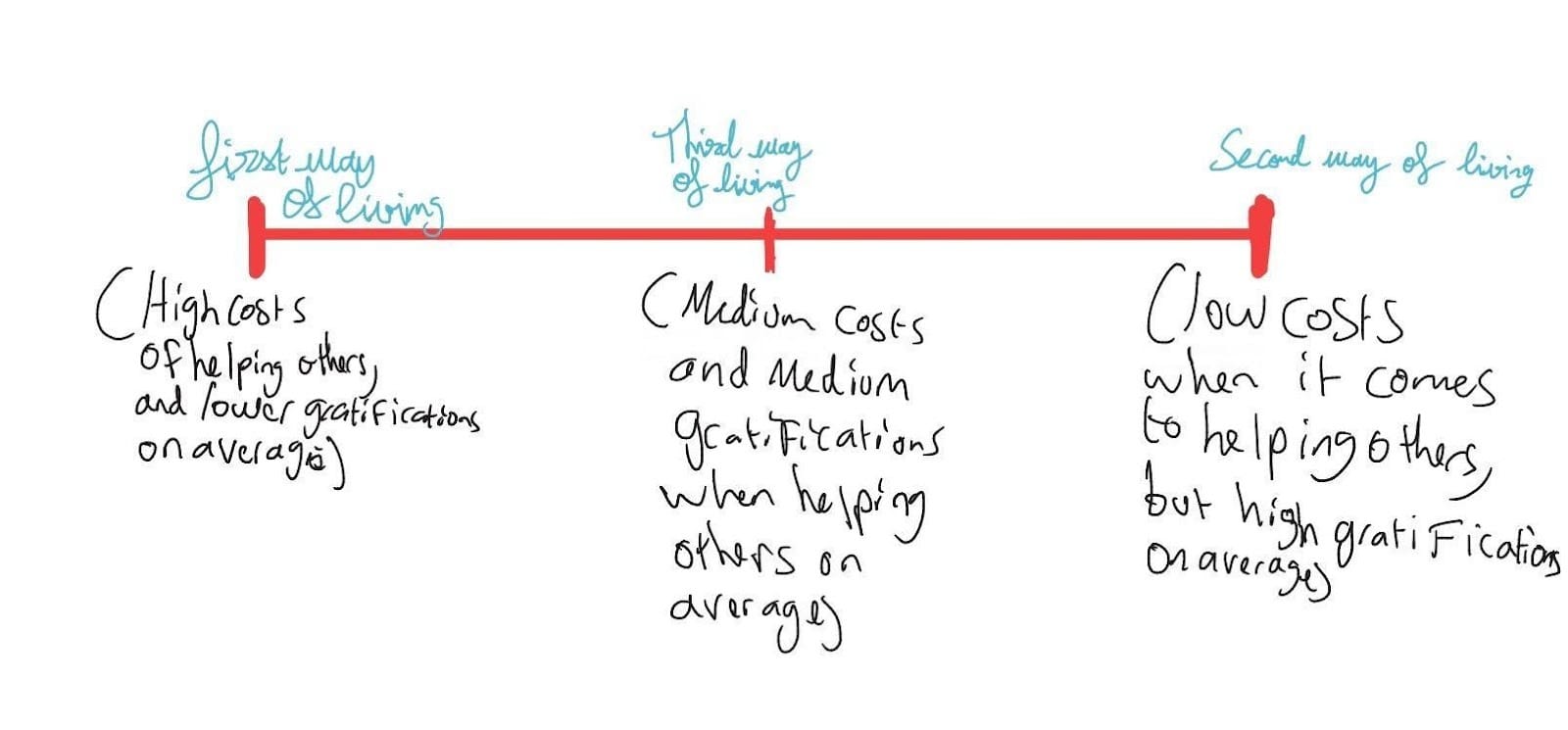
Through my article, I do not wish to create a pessimistic view of human nature and turn you into a nihilist that has completely given up on humanity and this world; just because we are selfish in nature does not mean that as a species we are inherently bad. The idea of selfishness has been given this negative connotation, and we see it as a sort of disease that we need to exterminate from our lives. In reality, selfishness and self interest is the only thing that led to the survival of our kind and is in essence what makes us humans. Being selfish does not mean that you do not care about others, it just means that you have other values at play that you prioritize in your life, which is perfectly fine due to the fact that ultimately we have the same boiled-down objectives to reach (survival and comfort). I believe that the reason behind why we dislike selfishness so much is because, throughout our history people have had tendencies to over-indulge in selfishness which may come at the cost of others and ruin the harmony of co-existence. As a result we took an extreme route of identifying all forms of selfishness as purely bad, and that is where the disdain for selfishness began. Self-interest in the metaphysical sense is a good concept because it ensures our survival and enjoyment of life, it is our interpretation of the concept that makes it bad.
To conclude this article, human nature is inherently selfish. Selfishness is not always directly linked to all of our actions, but boiled down they all lead back to the fulfillment of the common goals of surviving and reaching comfort. As a result of wanting to reach these goals, we have created concepts of morality and respect as a way to govern ourselves, and operate under a system that allows for a common existence of all human beings. But different people have different values as a result of their environments and cultures. They will then choose different ways in which their individual actions lead to the boiled down goals of survival and comfort. It is however important to remember that selfishness in essence is not a negative concept as we imagine it to be, but it is what makes us humans.
Read the original submission: